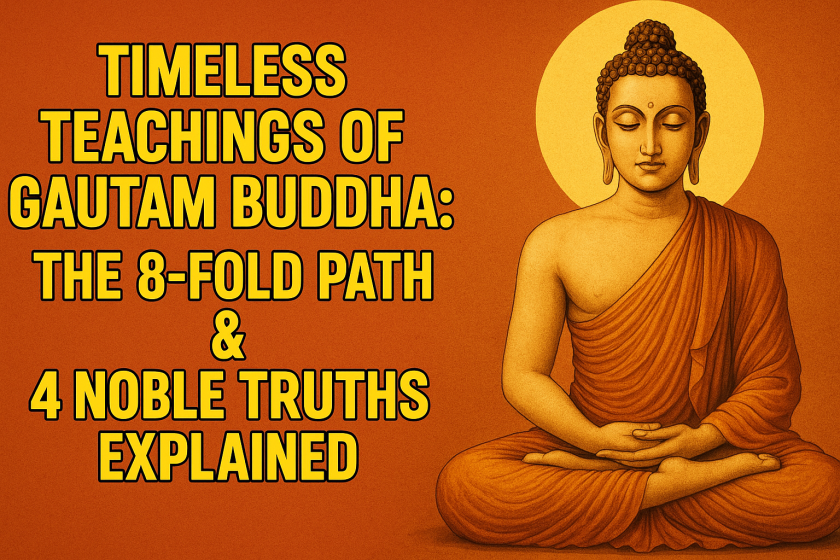
Teachings of Gautam Buddha: The 8-Fold Path & 4 Noble Truths Explained
🪷 “Timeless Teachings of Gautam Buddha: The 8-Fold Path & 4 Noble Truths Explained”
🧘♂️ Introduction: Why Buddha’s Teachings Matter Today
In a world filled with chaos, confusion, and constant distractions, the teachings of Gautam Buddha shine like a guiding light. Born as Siddhartha Gautama in the 6th century BCE, he renounced royal luxuries to seek the truth of human suffering. Through deep meditation and reflection, he attained Enlightenment under the Bodhi tree in Bodh Gaya and became Lord Buddha, “The Awakened One.”
More than 2500 years later, his wisdom — especially the Four Noble Truths and the Eightfold Path — remains incredibly relevant for anyone seeking inner peace, clarity, and purpose in life.
🌟 The Foundation of Buddha’s Teachings
Before diving deep into the core teachings, let’s understand the heart of Buddha’s message. He taught that:
- Suffering (dukkha) exists in all forms of life.
- There is a cause of suffering.
- Suffering can be ended.
- There is a way to end it.
These four points form the Four Noble Truths, the foundation of all Buddhist philosophy and spiritual practice.
🪔 The Four Noble Truths (Chatur Arya Satya)
1. The Truth of Suffering (Dukkha)
Everything in life is temporary and subject to change. Even pleasure turns into pain, joy fades, and attachment leads to grief. This suffering includes birth, aging, illness, death, separation from loved ones, and unfulfilled desires.
“Life is suffering” — this doesn’t mean life is misery, but that suffering is part of the human condition.
High-Search Keywords: suffering in buddhism, buddha quotes on pain, what is dukkha
2. The Truth of the Cause of Suffering (Samudaya)
Buddha identified desire (tanha), attachment, and ignorance as the root causes of suffering. We crave for wealth, relationships, recognition, and control — and this endless craving brings dissatisfaction.
Keywords: buddha on desire, attachment causes suffering, origin of suffering
3. The Truth of the End of Suffering (Nirodha)
There is hope. The cycle of suffering can be ended by eliminating attachment and desires. This state of total peace and liberation is called Nirvana — freedom from the cycle of rebirth (Samsara).
Keywords: nirvana in buddhism, end of suffering, freedom from desire
4. The Truth of the Path to End Suffering (Magga)
The solution lies in walking the Eightfold Path, a middle way between indulgence and self-denial. This path is the practical guideline to achieve liberation.
Keywords: eightfold path explained, buddha’s path to enlightenment, middle path in buddhism
🛤️ The Noble Eightfold Path (Ashtangika Marg)
The Eightfold Path is not a step-by-step process, but a set of interconnected principles to be practiced simultaneously. It’s divided into 3 major categories: Wisdom (Prajna), Ethical Conduct (Sila), and Mental Discipline (Samadhi).
🧠 1. Right View (Samma Ditthi)
Understanding reality as it is — not as we want it to be. This includes understanding the Four Noble Truths and seeing the world with clarity and compassion.
Keywords: right understanding in buddhism, buddha philosophy, gautam buddha teachings
🗣️ 2. Right Intention (Samma Sankappa)
Having pure thoughts, free from hatred, greed, or cruelty. It promotes goodwill, compassion, and non-attachment.
Keywords: intention in buddhism, buddha path of purity, right thought
🧘 3. Right Speech (Samma Vaca)
Speak truthfully, kindly, and wisely. Avoid lying, gossip, or speech that harms others.
Keywords: buddha on truth, right speech explained, speech ethics in buddhism
🙌 4. Right Action (Samma Kammanta)
Live morally by not harming others, stealing, or engaging in sexual misconduct. It’s about respecting all forms of life.
Keywords: buddhist way of life, ethical conduct, buddha teachings on actions
💼 5. Right Livelihood (Samma Ajiva)
Choose a profession that does not harm others or go against ethical values. Avoid jobs related to weapons, human trafficking, intoxicants, or killing.
Keywords: right livelihood buddhism, ethical career choices, buddha job principles
🧠 6. Right Effort (Samma Vayama)
Work towards self-growth, remove negative thoughts, and develop positive mental states. Practice discipline and persistence.
Keywords: buddha teachings on effort, self-discipline buddhism, mental strength
🧘♀️ 7. Right Mindfulness (Samma Sati)
Be aware of your body, thoughts, emotions, and surroundings in the present moment. This is the core of mindfulness meditation today.
Keywords: buddha mindfulness, mindful living, awareness in buddhism
🧘♂️ 8. Right Concentration (Samma Samadhi)
Practice deep meditation to reach higher states of consciousness and ultimately Enlightenment.
Keywords: buddha meditation techniques, samadhi explained, spiritual concentration
🌍 Why These Teachings Are Still Relevant in 2025
In today’s fast-paced digital life, where anxiety, depression, and stress are common, Buddha’s teachings offer a timeless mental health toolkit:
- The Four Noble Truths help you recognize and overcome emotional pain.
- The Eightfold Path gives a blueprint for ethical, peaceful, and meaningful living.
- Mindfulness and meditation, derived from Buddhism, are now used worldwide for mental wellness.
🛕 Conclusion: Walk the Path, Change Your Life
Gautam Buddha never claimed to be a god. He was a seeker of truth — just like you and me. His teachings show that Enlightenment is possible for anyone who walks the path sincerely.
If you want to live a life of clarity, purpose, compassion, and peace, start practicing even one part of the Eightfold Path. The journey is yours — and Buddha has already shown the way.
“You yourself must strive. The Buddhas only point the way.” – Gautam Buddha
🧩 FAQs (Add This for SEO Boost)
Q1: What is the main message of Gautam Buddha?
A: The core message is to overcome suffering through self-awareness, ethical living, and meditation, leading to Nirvana.
Q2: What are the 4 Noble Truths in Buddhism?
A: Suffering exists, it has a cause, it can be ended, and there is a path (Eightfold Path) to end it.
Q3: Is Buddhism a religion or philosophy?
A: It is both — a spiritual philosophy and a way of life based on compassion, ethics, and self-realization.
Keywords Used: Gautam Buddha teachings, Four Noble Truths, Eightfold Path, Buddha philosophy, Buddhist principles, Lord Buddha, life of Gautam Buddha, teachings of Buddha, path to enlightenment
Note:
Jai Bhim! Namo Buddhay! Friends, welcome to Nagvanshingo. If you find any information on our page incorrect or if you would like to share any additional information with us, please contact us at nagbbs50@gmail.com.
Your comment is awaiting moderation.
Врач фиксирует исходные данные (АД/ЧСС/SpO?, глюкоза, при необходимости — экспресс Na?/K?), оценивает дыхательный паттерн, проверяет ориентировку и уровень тревожности. После этого начинается титрованная инфузия с контролем каждые 15–20 минут, параллельно обучаем простым ритуалам вечернего времени: свет, вода, дыхание, короткие «заземляющие» действия. В конце визита пациент и близкие получают понятную памятку с «зелёными зонами» и признаками, при которых нужно выходить на связь немедленно. При необходимости на второй день назначается «контрольная точка» — очная или онлайн.
Получить дополнительные сведения – врач нарколог на дом