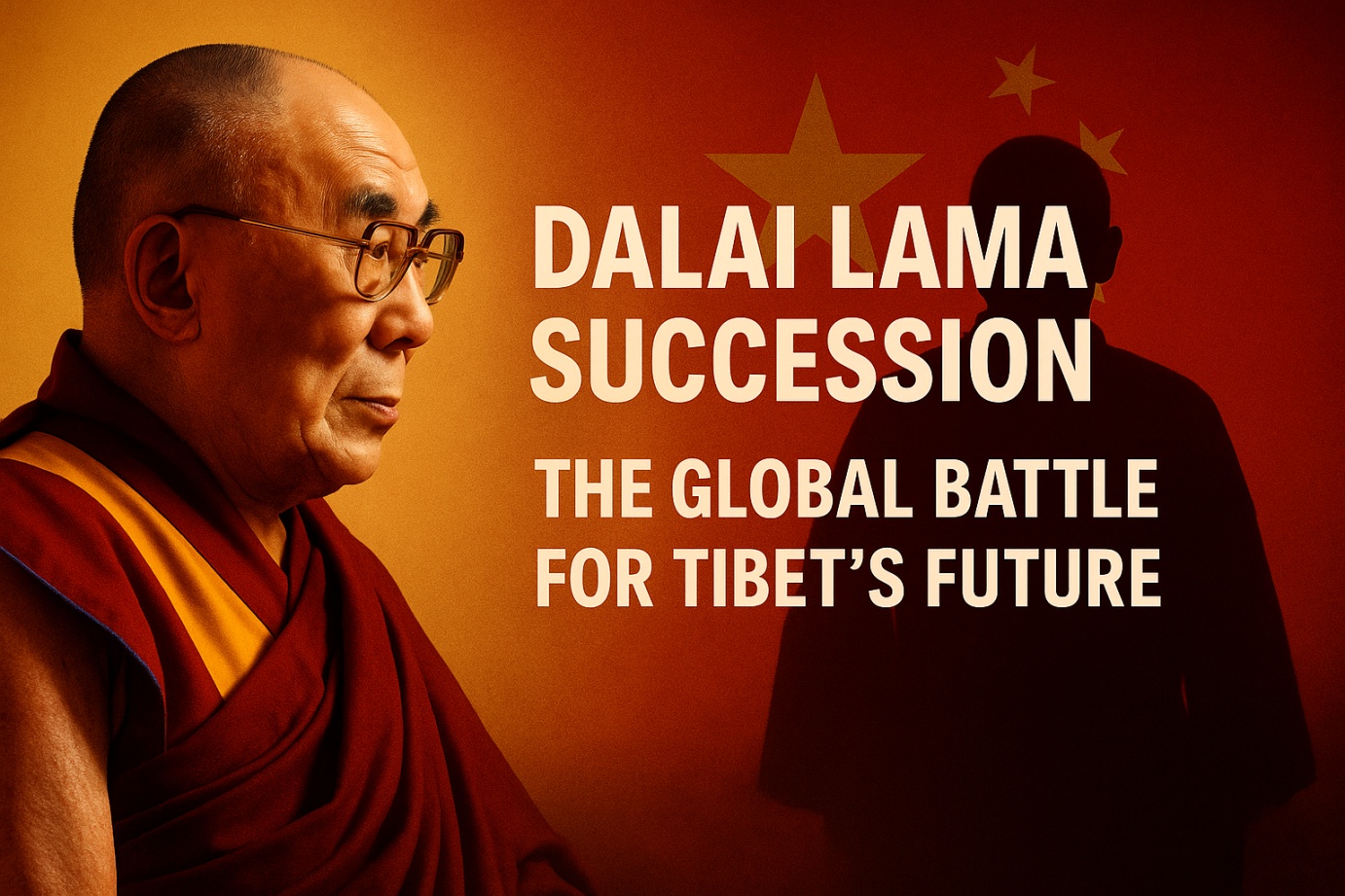
“Dalai Lama Succession: The Global Battle for Tibet Freedom and Future”
“Dalai Lama Succession: The Global Battle for Tibet’s Freedom and Future”
Introduction Tibet freedom
The future of Tibet hangs in the balance, and at the center of this struggle is the question of who will succeed the 14th Dalai Lama. This is no ordinary spiritual succession — it is a global political battle involving China’s determination to control Tibetan Buddhism, India’s unwavering support for the Tibetan cause, and the worldwide Buddhist community’s effort to preserve its sacred traditions. Tibet freedom
The Dalai Lama is more than a religious leader; he is a symbol of Tibetan identity, resistance, and hope. His succession will determine whether Tibetan Buddhism remains free from political influence or becomes another tool in Beijing’s expanding geopolitical agenda.
The Dalai Lama’s Global Significance Tibet freedom
Born Tenzin Gyatso in 1935, the 14th Dalai Lama has spent decades as the spiritual leader of Tibetan Buddhism and an international advocate for peace, non-violence, and human rights. His teachings have inspired millions across the globe, from the monasteries of the Himalayas to the streets of New York, London, and Tokyo.
But his role is not just spiritual. For the Tibetan people — both in Tibet and in exile — he represents their cultural survival and resistance to Chinese rule. Losing the independence to choose his successor would mean losing a critical pillar of Tibetan autonomy.
The Traditional Process of Succession
In Tibetan Buddhism, when a Dalai Lama passes away, senior monks search for his reincarnation based on visions, dreams, and spiritual signs. This is a deeply sacred process, rooted in centuries-old practices and guided solely by the Buddhist faith.
This tradition ensures that the next Dalai Lama continues the spiritual mission of compassion, wisdom, and service to humanity.
China’s Attempt to Control the Process
Since its occupation of Tibet in 1950, China has sought to bring Tibetan Buddhism under its political authority. In 2007, Beijing introduced laws requiring that all reincarnations of “living Buddhas” must be approved by the government.
Also Read
Ashoka Vijayadashami: The Festival of Dharma, Victory & Inner Revolution
Samrat Ashok : महान मौर्य सम्राट का जीवन, युद्ध और बौद्ध धर्म की ओर यात्रा
For China, controlling the Dalai Lama’s succession would:
- Undermine the legitimacy of the exile community based in Dharamshala, India.
- Create a “state-approved” Dalai Lama loyal to Beijing.
- Erase a vital symbol of Tibetan independence.
This move is widely seen as an attempt to weaken the spiritual and cultural unity of Tibetans worldwide.
India’s Strategic and Moral Role
India has been home to the Dalai Lama and the Tibetan government-in-exile since 1959. In July 2025, India officially backed the Dalai Lama’s position that his successor should be chosen according to Tibetan Buddhist tradition, not by any political authority.
This stance:
- Strengthens India’s image as a defender of religious freedom.
- Counters China’s influence in the Himalayan Buddhist belt.
- Sends a strong signal of solidarity to Tibetans living in exile.
India’s support is not just moral — it’s strategic. It serves as a counterbalance to China’s growing presence in the Himalayas and South Asia.
International Reactions
The battle over the Dalai Lama’s succession is not confined to Asia. Countries like the United States, Japan, and members of the European Union have expressed their support for the Dalai Lama’s right to determine his successor. The United Nations has also emphasized that religious communities must be free from political interference.
However, Beijing continues to use its economic and diplomatic power to pressure countries into accepting its authority over Tibetan Buddhism.
The Risk of Two Dalai Lamas
If China goes ahead with appointing its own candidate while Tibetan monks select another, the world could see two rival Dalai Lamas — one chosen by the Tibetan tradition, another installed by Beijing.
Also Read
Ashoka Vijayadashami: The Festival of Dharma, Victory & Inner Revolution
Samrat Ashok : महान मौर्य सम्राट का जीवन, युद्ध और बौद्ध धर्म की ओर यात्रा
The consequences could be severe:
- A divided Buddhist community.
- Confusion among followers worldwide.
- Loss of a unified Tibetan voice in the struggle for autonomy.
The Battle for Tibet’s Cultural Survival
At its core, this succession debate is about more than leadership Tibet freedom — it is about the survival of Tibetan identity. For decades, Tibetans have struggled to preserve their language, culture, and religion under Chinese rule. The Dalai Lama has been their anchor, connecting the diaspora to their homeland.
Losing control of the succession process would mean losing a key cultural safeguard.
The Dalai Lama’s Vision for the Future
The Dalai Lama has made it clear that:
- His successor may be born outside Tibet to avoid political manipulation.
- He may even decide to end the Dalai Lama institution if it no longer serves its spiritual purpose.
- Ultimately, the choice belongs to the Tibetan people and their religious leaders, not to any government.
This vision reflects his lifelong belief in non-violence, compassion, and the power of moral authority over political force.
Why the World Should Care
The Dalai Lama’s succession is not just a Tibetan issue — it is a global test of our commitment to religious freedom, human rights, and cultural preservation. If the international community allows political forces to decide a spiritual leader’s future, it sets a dangerous precedent for all faiths.
Conclusion
The battle over the Dalai Lama’s succession will shape the future of Tibet freedom and could influence the balance of power in Asia. It is a struggle between ancient tradition and modern political ambition, between spiritual truth and state control.
For Tibetans, the outcome will determine whether their faith remains a beacon of hope — or becomes another casualty of geopolitical rivalry. For the world, it is a moment to decide whether we stand for freedom or remain silent in the face of cultural erasure.
Suggested Featured Image Description for Generation
A digital composite image showing the 14th Dalai Lama on one side, a shadowy silhouette of a monk on the other, with the Chinese flag in the background. Bold headline text: “Dalai Lama Succession – The Global Battle for Tibet’s Future”. Warm golden tones for the Dalai Lama’s side, deep red for the China side.
#DalaiLama #Tibet #Buddhism #TibetanFreedom #IndiaSupportsTibet #GlobalPolitics #TibetChinaConflict #BuddhistTradition #HumanRights #HimalayanBuddhism
Note:
Jai Bhim! Namo Buddhay! Friends, welcome to Nagvanshingo. If you find any information on our page incorrect or if you would like to share any additional information with us, please contact us at nagbbs50@gmail.com