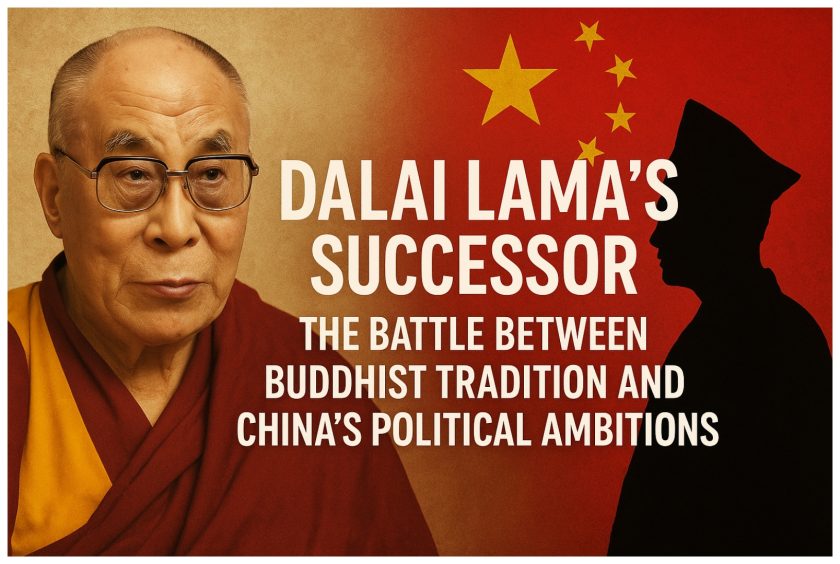
Dalai Lama’s Successor: The Battle Between Buddhist Tradition and China’s Political Ambitions”
Introduction
The question of who will succeed the 14th Dalai Lama’s Successor has sparked one of the most politically sensitive debates in modern religious history. This is not just a matter of spiritual succession — it is a geopolitical issue involving China’s claims over Tibet, India’s support for the Tibetan cause, and the global Buddhist community’s fight to protect sacred traditions.
In July 2025, the Dalai Lama reaffirmed that only his monastery and trusted followers will decide his successor, directly challenging Beijing’s attempts to control the process. For millions of Buddhists worldwide, this is about preserving religious freedom, resisting political interference, and safeguarding centuries-old traditions.
Who is the Dalai Lama?
The Dalai Lama is the spiritual leader of Tibetan Buddhism and is considered a living Bodhisattva — a being who has chosen rebirth to help others achieve enlightenment. The current 14th Dalai Lama, Tenzin Gyatso, was recognized in 1939 and has become an international symbol of peace, compassion, and non-violence.
For Buddhists, the Dalai Lama’s position is not simply an office — it is a sacred responsibility passed on through reincarnation. That’s why the succession process holds deep religious meaning.
Also Read
Ashoka Vijayadashami: The Festival of Dharma, Victory & Inner Revolution
Samrat Ashok : महान मौर्य सम्राट का जीवन, युद्ध और बौद्ध धर्म की ओर यात्रा
The Tradition of Reincarnation
Historically, when a Dalai Lama passes away, senior monks search for his reincarnation through spiritual signs, visions, and tests. This tradition is deeply embedded in Tibetan Buddhism and ensures that the next leader continues the spiritual work of his predecessor.
However, China’s Communist Party — officially atheist — has long tried to politicize this religious practice.
China’s Political Ambition
Since occupying Tibet in 1950, China has claimed the right to approve the Dalai Lama’s reincarnation. Beijing even passed laws in 2007 requiring all reincarnations of “living Buddhas” to be approved by the government.
Why? Because controlling the Dalai Lama’s successor would give China enormous influence over Tibetan Buddhism and reduce the power of the exile community led by the current Dalai Lama in Dharamshala, India.
China’s plan is clear: appoint a successor loyal to Beijing, creating a “state-approved” Dalai Lama who would undermine the legitimacy of the one chosen by the Tibetan tradition.
The Dalai Lama’s Response
The Dalai Lama has strongly rejected China’s claims. He has stated:
“The authority of choosing the next Dalai Lama lies with the people of Tibet and the Tibetan Buddhist tradition — no one else.”
In recent years, he has taken proactive steps, including:
- Suggesting the possibility of ending the Dalai Lama institution if it no longer serves its spiritual purpose.
- Proposing that his reincarnation could be found outside Tibet, possibly in India, to avoid Chinese control.
- Confirming that his monastery will lead the search for his successor — not any government.
India’s Stand on the Issue
India has hosted the Dalai Lama and the Tibetan government-in-exile since 1959. In July 2025, India officially backed the Dalai Lama’s position, clearly opposing China’s interference.
This is significant because:
- It strengthens India’s moral image as a supporter of religious freedom.
- It counters China’s influence in the Himalayan Buddhist belt.
- It reassures Tibetans in India, Nepal, and Bhutan that their traditions are safe.
India’s stance also reflects its strategic rivalry with China — supporting the Tibetan cause indirectly challenges Beijing’s territorial claims.
Also Read
Ashoka Vijayadashami: The Festival of Dharma, Victory & Inner Revolution
Samrat Ashok : महान मौर्य सम्राट का जीवन, युद्ध और बौद्ध धर्म की ओर यात्रा
Global Reactions
Countries like the US, Japan, and members of the European Union have also voiced support for the Dalai Lama’s right to decide his successor. The United Nations has called for respecting religious freedoms without political interference.
However, China continues to pressure foreign governments to accept its authority, warning them not to host Tibetan exile leaders or recognize the Dalai Lama’s chosen successor.
The Stakes for Tibetan Buddhism
If China succeeds in controlling the succession:
- Two rival Dalai Lamas may emerge — one chosen by the Tibetan tradition, another appointed by Beijing.
- The Tibetan community could face deeper division and confusion.
- Global Buddhist unity may be tested as political alliances influence religious choices.
If the Tibetan tradition prevails:
- Spiritual integrity will be preserved.
- The Dalai Lama’s message of compassion and non-violence will remain untarnished.
- Tibetans will retain a powerful symbol of resistance and cultural pride.
The Larger Message
This battle is not just about one leader. It represents a broader fight for:
- Religious Freedom — the right of a community to choose its spiritual path.
- Cultural Survival — protecting centuries-old traditions from political manipulation.
- Global Awareness — reminding the world that Tibet’s struggle is still alive.
The Dalai Lama’s life has been a lesson in patience and non-violence. His approach to this conflict reflects that same wisdom — resisting through moral authority rather than force.
Conclusion
The succession of the Dalai Lama will be a defining moment in the history of Tibetan Buddhism. Whether tradition or politics prevails will shape not just the future of Tibet, but also the moral credibility of the global community in defending religious freedom.
For now, the Dalai Lama remains a living bridge between the ancient spiritual wisdom of Tibet and the modern world’s urgent need for compassion. His successor — whenever and however chosen — will inherit both a sacred duty and a political storm.
Note:
Jai Bhim! Namo Buddhay! Friends, welcome to Nagvanshingo. If you find any information on our page incorrect or if you would like to share any additional information with us, please contact us at nagbbs50@gmail.com
#DalaiLama #Tibet #Buddhism #TibetanFreedom #IndiaSupportsTibet #SpiritualLeader #ReincarnationDebate #ChinaTibetConflict #BuddhistTradition #HimalayanBuddhism