The Legacy of Ashoka’s Dhamma: Lessons in Compassionate Governance for Today’s World
The Legacy of Ashoka’s Dhamma: Lessons in Compassionate Governance for Today’s World
In the pages of world history, few rulers have managed to combine political power with deep moral responsibility as effectively as Emperor Ashoka’s Dhamma . Known as Ashoka the Great, he ruled the Mauryan Empire in the 3rd century BCE, transforming it from a vast military empire into a beacon of peace and justice. His guiding philosophy—Dhamma—was not just a set of religious rules, but a comprehensive moral code that reshaped governance in ancient India.
Today, in an era of political polarization, environmental crises, and global conflict, Ashoka’s Dhamma offers timeless lessons in compassionate governance.
From Conquest to Compassion
Ashoka’s reign began like that of many powerful emperors—ambitious, strategic, and militaristic. But the turning point came with the Kalinga War (circa 261 BCE). The battle was victorious for the Mauryan army but left behind massive destruction, death, and human suffering.
Ashoka’s own inscriptions reveal his deep remorse:
“Even one hundredth or thousandth part of those who died or were killed would now be considered regrettable by Devanampiya (Beloved of the Gods).”
This personal transformation led Ashoka to embrace Buddhist teachings, renounce aggressive warfare, and focus on moral and social welfare.
Also Read
Ashoka Vijayadashami: The Festival of Dharma, Victory & Inner Revolution
Samrat Ashok : महान मौर्य सम्राट का जीवन, युद्ध और बौद्ध धर्म की ओर यात्रा
Dalai Lama’s Successor: The Battle Between Buddhist Tradition and China’s Political Ambitions”
What Was Ashoka’s Dhamma?
Ashoka’s Dhamma was a blend of Buddhist ethics and practical governance. It was not about forcing religion on his subjects but about promoting universal values that ensured harmony in a diverse empire.
Core principles of Ashoka’s Dhamma included:
- Non-violence (Ahimsa): Avoiding unnecessary harm to humans and animals.
- Religious Tolerance: Respecting all faiths and promoting inter-religious dialogue.
- Social Welfare: Providing medical facilities for humans and animals, building roads, wells, and rest houses.
- Justice and Fairness: Encouraging officials to be impartial and compassionate in their duties.
- Moral Responsibility: Encouraging self-control, truthfulness, and kindness.
How Ashoka Implemented His Dhamma
Ashoka was not content with simply preaching; he institutionalized Dhamma into the governance structure:
- Dhamma Mahamatras: Special officers appointed to promote ethical conduct, resolve disputes, and care for marginalized groups like prisoners and the poor.
- Edicts on Stone and Pillars: Messages carved across the empire to spread his principles—making him one of the earliest known leaders to use public communication for moral education.
- Animal Welfare: Establishing veterinary clinics and banning unnecessary animal slaughter.
- Infrastructure Development: Planting trees along roads, digging wells, and creating rest houses for travelers.
Also Read
Ashoka Vijayadashami: The Festival of Dharma, Victory & Inner Revolution
Samrat Ashok : महान मौर्य सम्राट का जीवन, युद्ध और बौद्ध धर्म की ओर यात्रा
Dalai Lama’s Successor: The Battle Between Buddhist Tradition and China’s Political Ambitions”
Relevance of Ashoka’s Dhamma in Modern Governance
The beauty of Ashoka’s Dhamma lies in its universality—it is as relevant today as it was 2,300 years ago.
1. Compassion in Policy Making
Modern governance often focuses on economic growth at the cost of human well-being. Ashoka’s Dhamma reminds us that empathy and welfare should be at the heart of policy-making.
2. Religious Harmony
In a world still divided by faith-based conflicts, Ashoka’s emphasis on mutual respect among religions offers a blueprint for peaceful coexistence.
3. Environmental Responsibility
Ashoka’s concern for animals and nature resonates strongly today, as climate change and biodiversity loss threaten our future.
4. Ethical Leadership
Ashoka’s personal transformation from a conqueror to a servant of the people shows that real leadership is about moral courage, not just political power.
Global Recognition of Ashoka’s Legacy
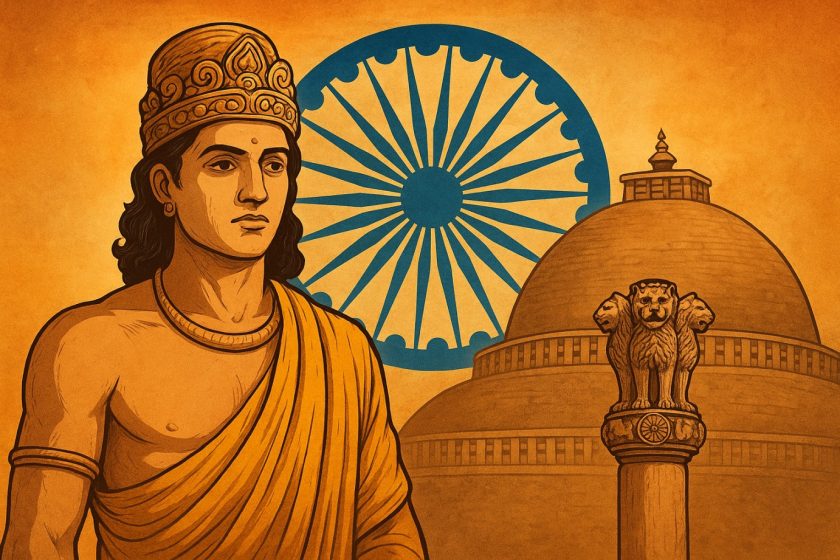
- The Ashoka Chakra on India’s national flag symbolizes the eternal wheel of law and justice.
- His lion capital is India’s national emblem, representing courage, pride, and unity.
- Internationally, historians regard him as one of the earliest rulers to advocate human rights and non-violence.
Also Read
Ashoka Vijayadashami: The Festival of Dharma, Victory & Inner Revolution
Samrat Ashok : महान मौर्य सम्राट का जीवन, युद्ध और बौद्ध धर्म की ओर यात्रा
Dalai Lama’s Successor: The Battle Between Buddhist Tradition and China’s Political Ambitions”
Challenges in Applying Ashoka’s Dhamma Today
While Ashoka’s ideals are inspiring, implementing them in modern times faces challenges:
- Political systems driven by short-term gains often overlook long-term ethical policies.
- Economic interests can conflict with environmental and social welfare goals.
- Religious tolerance remains difficult in polarized societies.
Yet, the essence of Dhamma—compassion, justice, and inclusivity—remains a guiding light for progressive governance.
Conclusion
Ashoka’s Dhamma was not just a political experiment; it was a moral revolution. In the 3rd century BCE, it united a vast and diverse empire through empathy, fairness, and respect for all life.
For today’s leaders, Ashoka’s legacy serves as a reminder that true greatness is not measured by the territories one conquers, but by the hearts one touches.
Final Thought:
In an age where the world is in dire need of compassionate governance, the wheel of Ashoka’s Dhamma must keep turning—not just in textbooks, but in policies, leadership, and the everyday actions of humanity.
#AshokaTheGreat #Dhamma #CompassionateGovernance #MauryanEmpire #BuddhistLeadership #HistoryLessons #PeaceAndTolerance #AshokaLegacy
Note:
Jai Bhim! Namo Buddhay! Friends, welcome to Nagvanshingo. If you find any information on our page incorrect or if you would like to share any! additional! information! with us, please contact us at nagbbs50@gmail.com