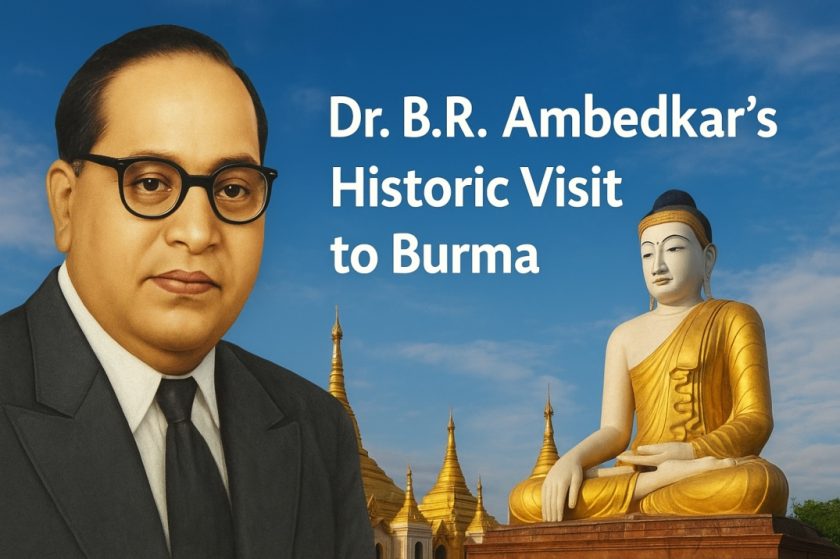
Dr. B.R. Ambedkar’s Historic Visit to Burma: A Journey Towards Buddhism and Social Revolution
Dr. B.R. Ambedkar’s Historic Visit to Burma: A Journey Towards Buddhism and Social Revolution
Introduction
Dr. Bhimrao Ramji Ambedkar, fondly remembered as Babasaheb, was not just the architect of the Indian Constitution but also a visionary social reformer who fought against caste discrimination and championed equality. Among the many turning points in his life, his visit to Burma (modern-day Myanmar) stands out as a historic and spiritual milestone. This journey brought him closer to Buddhism, a faith that eventually became the foundation of his socio-religious revolution in India.
The Burma visit is not often highlighted in mainstream history books, yet it carries great significance. It marked a phase in Babasaheb’s life where he explored Buddhism not only as a personal faith but also as a solution for the oppressed communities of India.
The Context of the Visit
In the early 20th century, Burma had a strong Buddhist cultural foundation. Buddhism was practiced by the majority of the people, and Burmese society reflected values of compassion, equality, and fraternity — the very principles Babasaheb envisioned for India.
Babasaheb, who was deeply disturbed by the oppressive caste system in Hinduism, had already begun to explore alternatives. His visit to Burma gave him a firsthand experience of a living Buddhist society where people lived with dignity, without the hierarchies of caste.
This exposure strengthened his belief that Buddhism was not merely a religion but a way of life that could liberate millions of oppressed people in India.
Ambedkar’s Observations in Burma
During his visit, Ambedkar engaged with Buddhist monks, scholars, and common people. Some of the key aspects he observed included:
- Equality in Society – Unlike caste-based discrimination in India, Burmese society treated people as equals under Buddhism.
- Role of Monks – Buddhist monks in Burma were not just spiritual guides but also educators and social reformers.
- Cultural Simplicity – The emphasis on simplicity, morality, and compassion impressed Ambedkar deeply.
- Community Life – Buddhist society in Burma was based on collective well-being rather than rigid hierarchies.
These observations confirmed for Babasaheb that Buddhism was the path to true liberty, equality, and fraternity — the values he had always cherished.
Also Read
Ashoka Vijayadashami: The Festival of Dharma, Victory & Inner Revolution
Samrat Ashok : महान मौर्य सम्राट का जीवन, युद्ध और बौद्ध धर्म की ओर यात्रा
Dalai Lama’s Successor: The Battle Between Buddhist Tradition and China’s Political Ambitions”
The Dhamma Policy of Ashoka: Lessons for Modern Governance
The Turning Point Towards Buddhism
Before visiting Burma, Ambedkar had already studied Buddhism through books and scriptures. However, seeing a Buddhist nation in practice gave him confidence that Buddhism could become the spiritual foundation for India’s oppressed classes.
It was this inspiration that sowed the seeds for his historic decision in 1956 at Deekshabhoomi, Nagpur, where he formally embraced Buddhism along with millions of his followers. The Burma visit thus acted as a spiritual bridge between his intellectual study of Buddhism and his practical adoption of it.
Political and Social Importance of the Visit
The Burma visit was not just spiritual but also political in nature. Ambedkar realized:
- A religion that supported social equality could serve as the foundation of a just society.
- Conversion to Buddhism was not a rejection of Hinduism alone but a declaration of human dignity.
- By adopting Buddhism, Dalits and other marginalized communities could unite under a common spiritual identity free from caste oppression.
This insight later shaped his movement known as the Dalit Buddhist Movement, which transformed the lives of millions.
Legacy of Ambedkar’s Burma Visit
The visit left a long-lasting impact on both India and Burma.
- In India, it directly influenced Ambedkar’s decision to embrace Buddhism and led to one of the largest mass religious conversions in history.
- In Burma (Myanmar), Ambedkar’s vision inspired Buddhist leaders and reformers to recognize the global significance of their faith.
- The visit also strengthened Indo-Burmese cultural ties, especially in the field of Buddhist studies and philosophy.
Today, scholars recognize that without this visit, Ambedkar’s decision to embrace Buddhism might have taken a different path or timeline.
Lessons for Modern Society
Ambedkar’s Burma visit is not just history; it carries important lessons for the present:
- Religion must support social justice – A faith is meaningful only if it upholds human dignity.
- Equality is non-negotiable – Social systems based on hierarchy are destined to fail.
- Cross-cultural learning – Just as Ambedkar learned from Burma, today’s world must learn from each other’s cultures and values.
- Peace through compassion – Buddhism’s message of compassion and fraternity remains vital for solving modern conflicts.
Also Read
Ashoka Vijayadashami: The Festival of Dharma, Victory & Inner Revolution
Samrat Ashok : महान मौर्य सम्राट का जीवन, युद्ध और बौद्ध धर्म की ओर यात्रा
Dalai Lama’s Successor: The Battle Between Buddhist Tradition and China’s Political Ambitions”
The Dhamma Policy of Ashoka: Lessons for Modern Governance
Conclusion
Dr. Babasaheb Ambedkar’s historic visit to Burma was more than just a travel experience; it was a spiritual awakening and political realization. The journey strengthened his faith in Buddhism as a path to liberation for the oppressed. This moment became a stepping stone to the great transformation at Deekshabhoomi in 1956, where he embraced Buddhism and gave millions a new identity based on dignity, equality, and fraternity.
Ambedkar’s Burma visit reminds us that true leadership is not only about politics or law but also about searching for truth and justice that can uplift humanity.
#Ambedkar #BurmaVisit #Babasaheb #Buddhism #SocialJustice #AmbedkarLegacy #Myanmar #DalitHistory
Note:
Jai Bhim! Namo Buddhay! Friends, welcome to Nagvanshingo. If you find any information on our page incorrect! or if you would like to share! any! additional! information! with us, please contact us at nagbbs50@gmail.com