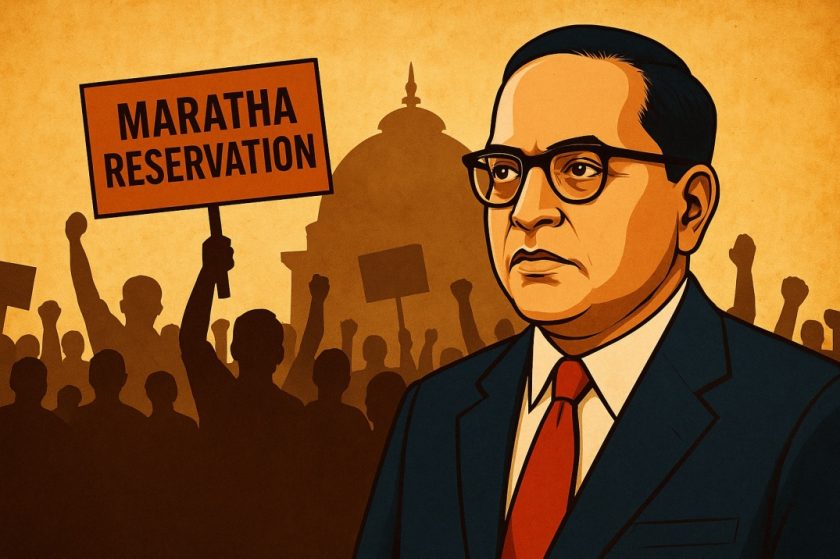
Babasaheb Ambedkar and the Maratha Reservation Debate: A True Perspective on Social Justice
Babasaheb Ambedkar and the Maratha Reservation Issue
The debate over Maratha Reservation Debate has been one of the most sensitive and politically charged issues in Maharashtra in the last two decades. The Maratha community, historically seen as a politically dominant caste, has demanded reservation in education and government jobs under the category of Socially and Educationally Backward Classes (SEBC). While the demand has found mass mobilization through protests, legal battles, and political promises, the question arises: What would Dr. Babasaheb Ambedkar, the architect of the Indian Constitution, have said about such a demand?
Ambedkar dedicated his life to upliftment of the most oppressed and marginalized castes, primarily the Scheduled Castes, Scheduled Tribes, and other backward classes who faced centuries of untouchability, exclusion, and deprivation. The question of Maratha reservation cannot be answered without first revisiting Ambedkar’s principles of social justice, equality, and his original idea behind the policy of reservations in India.
Ambedkar’s Views on Caste and Reservation
Dr. B. R. Ambedkar strongly believed that caste was the fundamental problem of Indian society. His demand for reservation was never based on economic poverty alone but on social exclusion rooted in the caste system. Ambedkar argued that certain castes, particularly the untouchables (Dalits), had been denied access to education, public spaces, employment, and basic dignity for thousands of years.
For Ambedkar, reservation was not a charity or economic subsidy but a constitutional right for representation. He wanted oppressed communities to have equal opportunities in education, administration, and political institutions. Therefore, he proposed reservations in legislatures, jobs, and educational institutions for Scheduled Castes and Scheduled Tribes as a means of corrective justice.
Thus, Ambedkar made it very clear: reservation is not for the socially dominant, but for the socially excluded.
Also Read
Ashoka Vijayadashami: The Festival of Dharma, Victory & Inner Revolution
Samrat Ashok : महान मौर्य सम्राट का जीवन, युद्ध और बौद्ध धर्म की ओर यात्रा
Dalai Lama’s Successor: The Battle Between Buddhist Tradition and China’s Political Ambitions”
The Dhamma Policy of Ashoka: Lessons for Modern Governance
Social and Educational Backwardness – Ambedkar’s Criteria
In the Constituent Assembly, Ambedkar differentiated between:
- Social Backwardness – Those communities excluded from temples, wells, schools, and villages due to untouchability or caste stigma.
- Educational Backwardness – Those communities deprived of access to learning because of systemic discrimination.
He emphasized that a caste may be poor but still socially powerful; hence poverty alone cannot justify reservation. Ambedkar was against extending caste-based privileges to communities that were historically rulers, landlords, or socially dominant.
The Maratha Community: Historical and Social Background
The Marathas are a dominant agrarian caste in Maharashtra, traditionally linked to landownership and political power. Historically, they led peasant movements, resisted Mughal rule under Chhatrapati Shivaji Maharaj, and later became powerful under the Maratha Empire.
Also Read
Ashoka Vijayadashami: The Festival of Dharma, Victory & Inner Revolution
Samrat Ashok : महान मौर्य सम्राट का जीवन, युद्ध और बौद्ध धर्म की ओर यात्रा
Dalai Lama’s Successor: The Battle Between Buddhist Tradition and China’s Political Ambitions”
The Dhamma Policy of Ashoka: Lessons for Modern Governance
In post-independence Maharashtra, Marathas continued to dominate politics, particularly through the Congress Party and later regional parties. Most Chief Ministers of Maharashtra came from the Maratha community. They controlled cooperatives, sugar factories, and educational institutions.
However, socio-economic changes in the 1990s and agricultural crises weakened their rural dominance. Many Maratha youth began demanding reservation to compete with OBCs and SC/STs in education and jobs.
Ambedkar’s Principles vs. Maratha Demand
If we look at Ambedkar’s ideology, the Marathas as a politically and socially dominant caste would not qualify as “backward” in his definition. They were never untouchables nor excluded from temples, wells, or education by caste stigma.
Ambedkar would have argued:
- Marathas face economic distress, not social exclusion.
- Economic solutions (like better farming policies, rural employment, scholarships) are needed, not caste-based reservations.
- Extending reservation to dominant castes dilutes the purpose of reservation meant for SC/ST and OBC communities who continue to face deep-rooted caste-based discrimination.
Thus, Ambedkar would likely have opposed caste-based reservation for Marathas but supported alternative welfare measures for their economic upliftment.
The Supreme Court and Constitutional Limits
The Supreme Court of India in 2021 struck down the Maratha reservation law passed by Maharashtra Government, stating that the 50% cap on total reservations must be maintained (as per Indra Sawhney case, 1992).
The Court noted that Marathas are a dominant forward community, not socially backward. This legal position aligns with Ambedkar’s principle that reservation must be based on historical social exclusion, not political pressure.
Also Read
Ashoka Vijayadashami: The Festival of Dharma, Victory & Inner Revolution
Samrat Ashok : महान मौर्य सम्राट का जीवन, युद्ध और बौद्ध धर्म की ओर यात्रा
Dalai Lama’s Successor: The Battle Between Buddhist Tradition and China’s Political Ambitions”
The Dhamma Policy of Ashoka: Lessons for Modern Governance
Impact on OBCs, SCs, and STs
The demand for Maratha reservation also affects existing backward classes. OBCs fear losing their share of quotas, SC/ST communities argue that the inclusion of dominant castes like Marathas will dilute the constitutional safeguard meant for them.
Ambedkar always warned that powerful castes may misuse reservation demands to maintain dominance, while truly marginalized groups remain underprivileged.
Ambedkar’s Vision of Social Justice
For Ambedkar, true social justice meant:
- Breaking the caste system.
- Ensuring equal dignity for all castes.
- Giving representation to the most oppressed in power structures.
He believed that dominant castes demanding reservation without social exclusion risk undermining the very spirit of the Constitution.
Ambedkar famously said: “Reservation is not a privilege, it is a remedy for historical wrongs.”
Current Political Narrative & Misuse of Ambedkar’s Name
In today’s Maharashtra politics, almost every party invokes Babasaheb Ambedkar’s name to justify or oppose Maratha reservation. Protest leaders often claim, “Ambedkar would have supported us,” while others argue the opposite.
The reality is that Ambedkar’s writings and speeches clearly show he prioritized untouchables and truly backward classes. Using his name for dominant caste politics is a distortion of history.
Conclusion – Ambedkar’s Actual Stand
The Maratha reservation debate raises important questions about the future of India’s reservation policy. If Babasaheb Ambedkar were alive today, he would likely have taken a principled stand:
- Reservations should remain exclusively for historically oppressed castes (SC, ST, OBC).
- Economically distressed dominant castes like Marathas should be supported through economic reforms, agricultural subsidies, and educational opportunities but not caste-based reservations.
Thus, Ambedkar’s vision of social justice was about representation for the powerless, not privileges for the powerful.
The Maratha reservation debate should remind us of Ambedkar’s ultimate goal: a society beyond caste, where opportunities depend not on birth but on talent, dignity, and equal rights Maratha Reservation Debate .
Also Read
Ashoka Vijayadashami: The Festival of Dharma, Victory & Inner Revolution
Samrat Ashok : महान मौर्य सम्राट का जीवन, युद्ध और बौद्ध धर्म की ओर यात्रा
Dalai Lama’s Successor: The Battle Between Buddhist Tradition and China’s Political Ambitions”
The Dhamma Policy of Ashoka: Lessons for Modern Governance
#BabasahebAmbedkar, #MarathaReservation, #SocialJustice, #IndianConstitution, #ReservationDebate, #MaharashtraPolitics, #AmbedkarThoughts, #EqualityForAll, #BRambedkar, #DalitHistory
Note:
Jai Bhim! Namo Buddhay! Friends, welcome to Nagvanshingo. If you find any information on our page incorrect! or if you would like to share! any! additional! information! with us, please contact us at nagbbs50@gmail.com