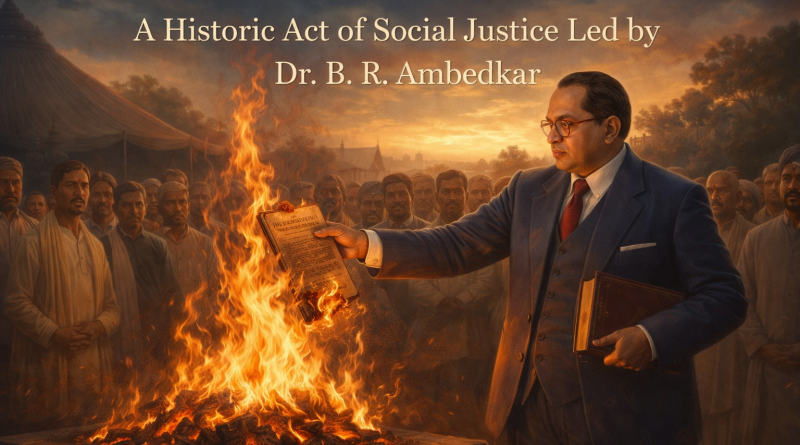
Manusmriti Dahan: A Historic Act of Social Justice Led by Dr. B. R. Ambedkar
Manusmriti Dahan: A Historic Act of Social Justice Led by Dr. B. R. Ambedkar
The history of India’s social reform movement is marked by several bold and revolutionary acts that challenged centuries-old systems of inequality. One such powerful and symbolic event was Manusmriti Dahan, the public burning of the Manusmriti on 25 December 1927. Led by Dr. B. R. Ambedkar, this act was not merely a protest against a religious text but a direct challenge to the ideology of caste-based discrimination that had oppressed millions for centuries.
Manusmriti Dahan stands as a landmark moment in India’s struggle for equality, dignity, and human rights, especially for Dalits and other marginalized communities.
What is Manusmriti?
The Manusmriti, also known as the Laws of Manu, is an ancient Sanskrit text traditionally associated with Hindu social law. It outlines rules related to social order, duties, and conduct. However, many of its verses promote rigid caste hierarchy, discrimination against Shudras and women, and unequal social rights.
For centuries, Manusmriti was used—directly or indirectly—to justify:
- Untouchability
- Denial of education to lower castes
- Social exclusion
- Unequal punishment under law
Dr. Ambedkar studied the text deeply and identified it as one of the ideological foundations of caste oppression.
Also Read
Ashoka Vijayadashami: The Festival of Dharma, Victory & Inner Revolution
Samrat Ashok : महान मौर्य सम्राट का जीवन, युद्ध और बौद्ध धर्म की ओर यात्रा
Dalai Lama’s Successor: The Battle Between Buddhist Tradition and China’s Political Ambitions”
The Dhamma Policy of Ashoka: Lessons for Modern Governance
Background: The Mahad Satyagraha
To understand Manusmriti Dahan, one must first understand the Mahad Satyagraha of 1927. Mahad was a town in present-day Maharashtra where Dalits were denied access to public water sources.
Under the leadership of Dr. B. R. Ambedkar, thousands of Dalits gathered to assert their right to drink water from the Chavdar Tank, a public tank legally open to all citizens. This peaceful assertion shook the caste-based social order and triggered violent backlash from orthodox sections.
The success of Mahad Satyagraha inspired Ambedkar to take the movement further — not just against practices, but against the texts that legitimized those practices.
Why Manusmriti Was Burned
Dr. Ambedkar believed that social slavery could not end unless its ideological roots were destroyed. According to him, Manusmriti was not a divine or neutral text but a man-made code that institutionalized inequality.
He clearly stated that:
- Social reform must begin by rejecting unjust scriptures
- Equality cannot coexist with caste-based religious authority
- True democracy requires social and moral equality
Thus, Manusmriti Dahan was a symbolic rejection of inequality, not an attack on religion but on social injustice.
Also Read
Ashoka Vijayadashami: The Festival of Dharma, Victory & Inner Revolution
Samrat Ashok : महान मौर्य सम्राट का जीवन, युद्ध और बौद्ध धर्म की ओर यात्रा
Dalai Lama’s Successor: The Battle Between Buddhist Tradition and China’s Political Ambitions”
The Dhamma Policy of Ashoka: Lessons for Modern Governance
The Event: Manusmriti Dahan, 25 December 1927
On 25 December 1927, during the second conference at Mahad, Dr. Ambedkar addressed a massive gathering of Dalits and reformers. After his speech, copies of Manusmriti were brought to the stage.
In a peaceful and dignified manner, the Manusmriti was publicly burned. The act sent a strong message across India:
- Oppression would no longer be accepted silently
- Dalits would challenge both social practices and their ideological justification
This event shocked orthodox Hindu society but energized the oppressed masses.
Reaction and Controversy
The burning of Manusmriti sparked intense debate across India:
- Orthodox groups condemned the act
- Reformists and progressives supported it
- Newspapers discussed it widely
- It brought caste discrimination into national political discourse
Despite criticism, Ambedkar stood firm. He clarified that no society can progress while treating human beings as unequal.
Manusmriti Dahan and Ambedkar’s Philosophy
Manusmriti Dahan was deeply connected to Ambedkar’s core beliefs:
- Liberty, Equality, Fraternity
- Social democracy before political democracy
- Rational thinking over blind tradition
Later in life, Ambedkar would famously say that Hindu society must be restructured, or the oppressed must find dignity elsewhere — a journey that eventually led to his embrace of Buddhism in 1956.
Also Read
Ashoka Vijayadashami: The Festival of Dharma, Victory & Inner Revolution
Samrat Ashok : महान मौर्य सम्राट का जीवन, युद्ध और बौद्ध धर्म की ओर यात्रा
Dalai Lama’s Successor: The Battle Between Buddhist Tradition and China’s Political Ambitions”
The Dhamma Policy of Ashoka: Lessons for Modern Governance
Long-Term Impact of Manusmriti Dahan
The significance of Manusmriti Dahan goes far beyond 1927:
- Empowered Dalit Consciousness
It inspired self-respect and resistance among oppressed communities. - Foundation of Anti-Caste Movement
The event became a milestone in India’s anti-caste struggle. - Influence on Indian Constitution
Ambedkar later ensured constitutional safeguards against caste discrimination. - Annual Commemoration
Even today, 25 December is observed by Ambedkarite movements as a day of resistance and social awareness.
Misinterpretations and Clarifications
It is important to clarify that Manusmriti Dahan was:
- ❌ Not hatred against any community
- ❌ Not an act of violence
- ✅ A peaceful symbolic protest
- ✅ A demand for human dignity
Ambedkar always emphasized reason, justice, and humanity, not blind opposition.
Relevance in Modern India
Even today, caste discrimination has not fully disappeared. Manusmriti Dahan remains relevant as:
- A reminder that inequality must be challenged at its roots
- A symbol of intellectual courage
- An inspiration for constitutional values
The event urges society to question traditions that conflict with human rights and democracy.
Conclusion
Also Read
Ashoka Vijayadashami: The Festival of Dharma, Victory & Inner Revolution
Samrat Ashok : महान मौर्य सम्राट का जीवन, युद्ध और बौद्ध धर्म की ओर यात्रा
Dalai Lama’s Successor: The Battle Between Buddhist Tradition and China’s Political Ambitions”
The Dhamma Policy of Ashoka: Lessons for Modern Governance
Manusmriti Dahan was not merely the burning of a book — it was the burning of an ideology that denied equality to millions. Led by Dr. B. R. Ambedkar, it marked a turning point in India’s social history.
The event stands as a powerful reminder that true freedom is incomplete without social justice, and that reform requires courage to challenge even the most deeply rooted beliefs.
Manusmriti Dahan remains one of the boldest and most meaningful acts in India’s long journey toward equality, dignity, and justice for all.
#ManusmritiDahan #DrBRAmbedkar #SocialJustice #AntiCasteMovement #DalitHistory #IndianSocialReform #AmbedkariteMovement #MahadSatyagraha #EqualityAndJustice
Note:
Jai Bhim! Namo Buddhay! Friends, welcome! to Nagvanshingo. If! you find any! information! on our page incorrect or if you! would! like to share! any additional! information! with us, please! contact us at nagbbs50@gmail.com.