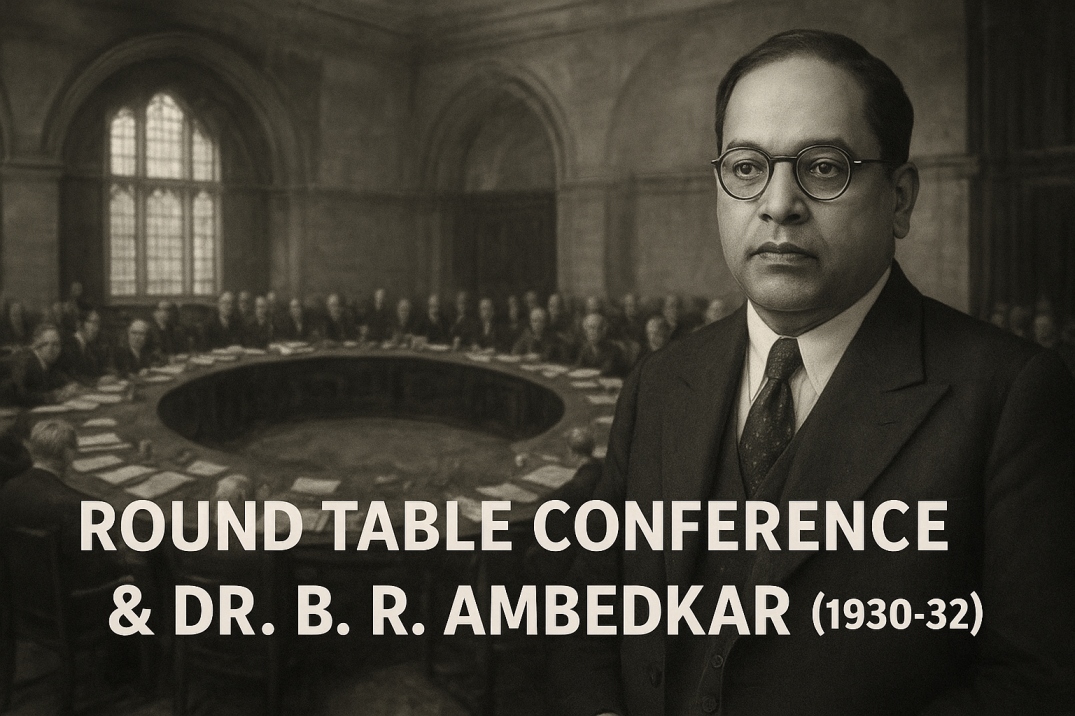
Round Table Conferences and Dr. B. R. Ambedkar: Shaping the Path of Social Justice in India
Round Table Conferences and Dr. B. R. Ambedkar: Shaping the Path of Social Justice in India
Introduction
The struggle for India’s independence was not just about political freedom from British colonial rule—it was also a battle for social justice, equality, and the eradication of centuries of discrimination. Among the greatest leaders who fought for this cause was Dr. B. R. Ambedkar, the voice of the oppressed and the architect of modern India’s social justice framework Round Table Conferences.
One of the most crucial moments in Ambedkar’s political journey was his participation in the Round Table Conferences (1930–1932) in London. These conferences were organized by the British government to discuss constitutional reforms for India. While national leaders like Mahatma Gandhi represented the Congress, Ambedkar stood firm as the representative of the “Depressed Classes” (Dalits), ensuring that the voices of millions of marginalized people were heard on an international stage.
This blog will explore the history of the Round Table Conferences, Ambedkar’s role, his differences with Gandhi, the significance of the Poona Pact of 1932, and its long-term impact on Indian society.
Background: Why Were the Round Table Conferences Held?
The Simon Commission (1927), which excluded Indian representatives, was boycotted by the Congress and other political groups. In response, the British government invited Indian leaders to London for discussions on India’s future political setup.
Thus, three Round Table Conferences were held:
Also Read
Ashoka Vijayadashami: The Festival of Dharma, Victory & Inner Revolution
Samrat Ashok : महान मौर्य सम्राट का जीवन, युद्ध और बौद्ध धर्म की ओर यात्रा
Dalai Lama’s Successor: The Battle Between Buddhist Tradition and China’s Political Ambitions”
The Dhamma Policy of Ashoka: Lessons for Modern Governance
- First Round Table Conference (November 1930 – January 1931)
- Attended by leaders like Dr. B. R. Ambedkar, Tej Bahadur Sapru, and others.
- Congress boycotted it, but Ambedkar made his presence strongly felt.
- Second Round Table Conference (September – December 1931)
- Mahatma Gandhi attended as the sole representative of the Indian National Congress.
- This conference became historic due to the clash between Gandhi and Ambedkar on the question of Dalit representation.
- Third Round Table Conference (November – December 1932)
- Limited participation; Ambedkar attended and continued to press for constitutional safeguards for Dalits.
Dr. B. R. Ambedkar’s Role in the Round Table Conferences
Ambedkar’s presence at the conferences was historic because for the first time, the “Depressed Classes” were directly represented in negotiations with the British government. His arguments were clear, logical, and uncompromising:
- He demanded separate electorates for Dalits, so that they could elect their own representatives without interference from the upper castes.
- He argued that without political power, social reforms would remain incomplete.
- Ambedkar emphasized that political independence without social equality would only benefit the privileged castes and not the millions of oppressed Indians.
Ambedkar’s speeches stunned the British officials and Indian leaders alike. The London press even called him “the real leader of the untouchables.”
Also Read
Ashoka Vijayadashami: The Festival of Dharma, Victory & Inner Revolution
Samrat Ashok : महान मौर्य सम्राट का जीवन, युद्ध और बौद्ध धर्म की ओर यात्रा
Dalai Lama’s Successor: The Battle Between Buddhist Tradition and China’s Political Ambitions”
The Dhamma Policy of Ashoka: Lessons for Modern Governance
The Clash with Mahatma Gandhi
The Second Round Table Conference (1931) became famous for the sharp disagreements between Ambedkar and Gandhi.
- Ambedkar’s Stand: Separate electorates for Dalits to ensure true representation and political empowerment.
- Gandhi’s Stand: He opposed separate electorates, fearing it would divide Hindu society permanently. Gandhi instead proposed joint electorates with reserved seats.
The disagreement became so intense that it led to a major crisis in Indian politics.
The Poona Pact of 1932
When the British Prime Minister Ramsay MacDonald announced the Communal Award (1932) granting separate electorates for Dalits, Gandhi opposed it by starting a fast unto death in Yerwada Jail, Pune.
Ambedkar faced immense pressure, as the situation could have led to Gandhi’s death and nationwide unrest. After intense negotiations, the Poona Pact was signed on 24 September 1932 between Ambedkar and Gandhi.
Key Provisions of the Poona Pact:
- Separate electorates for Dalits were withdrawn.
- Instead, Dalits were given reserved seats in joint electorates.
- The number of seats for the Depressed Classes was significantly increased (148 seats in provincial legislatures and 18% in Central Legislature).
- The pact also promised better educational and social opportunities for Dalits.
While Ambedkar signed the pact under immense pressure, he later described it as a “compromise forced upon him.” However, it also laid the foundation for the reservation policy that continues in India today.
Impact of Ambedkar’s Participation
Ambedkar’s role in the Round Table Conferences was revolutionary:
- He internationalized the Dalit question by raising it in front of the British and the world.
- He exposed the hypocrisy of upper-caste leaders who sought freedom from the British but ignored social freedom for Dalits.
- His arguments! eventually influenced the policies of reservation, affirmative action, and representation in independent India.
- The Poona Pact became a turning! point in Indian politics, shaping the future of electoral democracy.
Also Read
Ashoka Vijayadashami: The Festival of Dharma, Victory & Inner Revolution
Samrat Ashok : महान मौर्य सम्राट का जीवन, युद्ध और बौद्ध धर्म की ओर यात्रा
Dalai Lama’s Successor: The Battle Between Buddhist Tradition and China’s Political Ambitions”
The Dhamma Policy of Ashoka: Lessons for Modern Governance
Modern Relevance of Ambedkar’s Vision
Even today, Ambedkar’s struggles at the Round Table Conferences remind us of several truths:
- Political freedom is incomplete without social justice.
- Representation of marginalized communities is essential in any democracy.
- Compromises like the Poona Pact may be temporary, but long-term social reforms need constant effort.
- The principles Ambedkar fought for continue to guide India’s Constitution, reservation system, and democratic ideals.
Conclusion
The Round Table Conferences of 1930–32 were not just constitutional discussions—they were! battles of ideas, vision, and justice. Dr. B. R. Ambedkar’s fearless participation ensured that the voices of millions of Dalits were heard on the global stage.
While the Poona Pact was a compromise, it was also the beginning! of Dalit representation in Indian politics. Ambedkar’s legacy in these conferences! continues to inspire struggles for equality, dignity, and human rights across the world.
#Ambedkar #RoundTableConference #PoonaPact #DalitHistory #SocialJustice #IndianHistory #BabasahebAmbedkar
Note:
Jai Bhim! Namo Buddhay! Friends, welcome to Nagvanshingo. If you find any information on our page incorrect! or if you would like to share! any! additional! information! with us, please contact us at nagbbs50@gmail.com