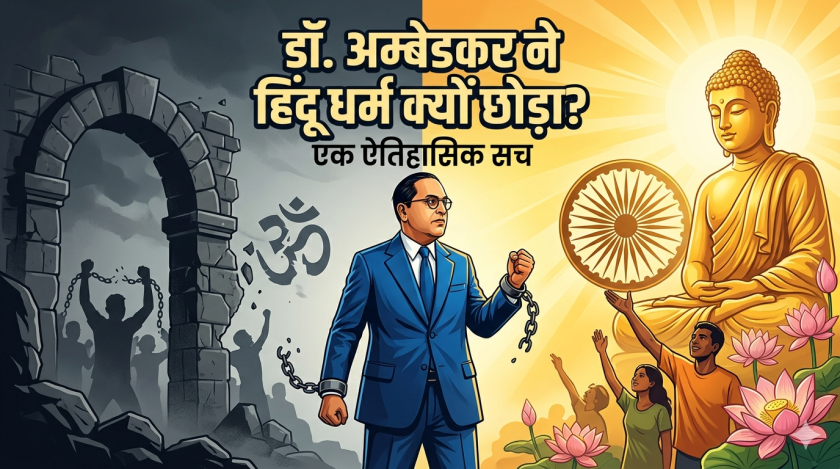
Why Dr. Ambedkar Renounced Hinduism: The Untold Historical Truth
Why Dr. Ambedkar Renounced Hinduism: The Untold Historical Truth
Dr. B.R. Ambedkar’s role as the chief architect of the Indian Constitution is widely celebrated across the globe. His brilliance as a jurist, economist, and social reformer has left an indelible mark on the history of modern India. However, while his political and legal achievements are well-documented, his profound views on religion—particularly his monumental decision to renounce Hinduism, the religion of his birth—are often underexplored or misunderstood by the masses Ambedkar Renounced Hinduism.
For a man who spent his entire adult life fighting a relentless battle against social injustices, religion was not just a matter of spiritual belief; it was a matter of human dignity, social equality, and basic human rights. In the final chapter of his life, Dr. Ambedkar took a historic step that shook the foundations of the Indian social fabric: he renounced Hinduism and embraced Buddhism.
But what drove one of the greatest minds of the 20th century to make such a radical departure from the faith he was born into? By diving deep into his speeches, writings, and interviews—such as The Buddha and His Dhamma, Annihilation of Caste, and Philosophy of Hinduism—we can uncover the highly rational, deeply moral, and socially urgent reasons behind his historic conversion.
Also Read
Ashoka Vijayadashami: The Festival of Dharma, Victory & Inner Revolution
Samrat Ashok : महान मौर्य सम्राट का जीवन, युद्ध और बौद्ध धर्म की ओर यात्रा
Dalai Lama’s Successor: The Battle Between Buddhist Tradition and China’s Political Ambitions”
The Dhamma Policy of Ashoka: Lessons for Modern Governance
The Burden of Untouchability: A Lifelong Battle
To understand Dr. Ambedkar’s departure from Hinduism, one must first understand the social context of his life. Born into the Mahar caste, which was considered “untouchable” by orthodox Hindu society, Ambedkar faced severe discrimination from a very young age. Despite his extraordinary intellectual capabilities and academic achievements across global institutions like Columbia University and the London School of Economics, he was constantly reminded of his “lowly” status within the traditional Hindu social hierarchy.
Ambedkar realized early on that the discrimination! he and millions of others faced was not an anomaly but a systemic feature! of the society they lived in. The systemic! oppression was deeply rooted in the doctrine of Chaitanya (the four-tier caste system), which he believed was sanctioned and upheld by Hindu religious texts. For decades, he attempted to reform the religion from within.
He led movements! for temple entry, fought for equal access to public water tanks (such as the Mahad! Satyagraha), and demanded! basic human rights! for the Depressed Classes. However, his efforts to secure equal status and “ordinary rights as human beings” within the Hindu fold were consistently met with rigid resistance from orthodox elements.
The Turning Point: The Yeola Conference of 1935
The realization that internal! reform was impossible culminated in a historic declaration. The year 1935 marked a definitive turning point in Dr. Ambedkar’s ideological! journey. Addressing a massive gathering at the Yeola Conference, he made a statement that! would echo through the corridors of history.
He declared that the untouchables occupied a weak and lowly status! entirely because they were tethered to a society that refused to treat them as human beings. Having exhausted all avenues for securing equal rights within the religion of his birth, Ambedkar concluded that it was absolutely essential to embrace a new religion.
Also Read
Ashoka Vijayadashami: The Festival of Dharma, Victory & Inner Revolution
Samrat Ashok : महान मौर्य सम्राट का जीवन, युद्ध और बौद्ध धर्म की ओर यात्रा
Dalai Lama’s Successor: The Battle Between Buddhist Tradition and China’s Political Ambitions”
The Dhamma Policy of Ashoka: Lessons for Modern Governance
He instructed his thousands of followers! with a! clear, pragmatic directive: “Select only that religion in which you will get equal status, equal opportunity, and equal treatment.” It was at this very conference that he made his famous, thunderous! vow: “I was born! a Hindu, but I will not die a Hindu.” This was not an emotional outburst; it was a deeply calculated and philosophical decision made after years of suffering, observation, and analysis.
The Search for the Ideal Religion
Following the Yeola declaration, Dr. Ambedkar embarked on a rigorous comparative study of world religions. He spent over two decades examining the tenets, social structures, and historical impacts of various faiths, including Islam, Christianity, Sikhism, and Buddhism. His goal was not to seek personal salvation or a pathway to the afterlife, but to find a social philosophy that could serve as a moral foundation for a just and equal society.
In an insightful article titled “Buddha and the Future of his Religion,” published in 1950 in the Mahabodhi Society Journal, Ambedkar laid out his criteria for what an ideal religion must entail in the modern world:
- The Sanction of Morality: Ambedkar argued that society must be held together either by the sanction of law or the sanction of morality. Without either, society is guaranteed to disintegrate. Religion, therefore, must provide a strong moral compass.
- Consonance with Reason and Science: For a religion to survive the test of time, it must not rely on blind faith or superstition. It must be in alignment with reason, which Ambedkar beautifully equated as “another name for science.”
- Liberty, Equality, and Fraternity: A mere moral code is insufficient. The fundamental tenets of any valid religion must recognize and promote liberty, equality, and fraternity—the very principles that Ambedkar later enshrined in the Preamble of the Indian Constitution.
- No Sanctification of Poverty: Religion must not glorify suffering or make a virtue out of poverty. It should uplift human life, not rationalize its miseries.
According to Dr. Ambedkar’s exhaustive research, Buddhism was the only existing religion that successfully fulfilled all these stringent requirements.
Also Read
Ashoka Vijayadashami: The Festival of Dharma, Victory & Inner Revolution
Samrat Ashok : महान मौर्य सम्राट का जीवन, युद्ध और बौद्ध धर्म की ओर यात्रा
Dalai Lama’s Successor: The Battle Between Buddhist Tradition and China’s Political Ambitions”
The Dhamma Policy of Ashoka: Lessons for Modern Governance
The Philosophical Critiques of Hinduism
Dr. Ambedkar’s rejection of Hinduism was heavily rooted in his critique of its fundamental structures. In his writings, he enumerated several core evils that he believed made the religion incompatible with human progress and social justice:
- Deprivation of Moral Freedom: Ambedkar argued that what was termed as “religion” by the orthodox framework was, in reality, nothing but a multitude of strict commands and prohibitions. It deprived the individual of moral freedom, reducing religious life to mere conformity to ancient rules.
- Unjust and Unequal Laws: He pointed out that the traditional laws were fundamentally unjust because they were not uniform. The penal codes, social rights, and privileges varied drastically depending on the class or caste one belonged to, thereby institutionalizing inequality.
- Finality of the Code: Ambedkar heavily criticized the notion that the ancient codes were treated as absolute, final, and unquestionable, leaving no room for progressive evolution or rational questioning.
In a speech delivered on Buddha Jayanti day in Delhi in 1950, he made a sharp distinction between the founders of other religions and the Buddha. While others often considered themselves as divine emissaries or prophets of God, the Buddha regarded himself merely as a guide (Margadata). By doing so, the Buddha gave a revolutionary, democratic meaning to the concept of religion. Ambedkar bluntly stated that while Hinduism stood for inequality, Buddhism stood firmly for equality.
The Three Pillars: Prajna, Karuna, and Samata
As Dr. Ambedkar drew closer to his formal conversion, he became increasingly vocal about the specific philosophical elements that drew him to the Dhamma. In May 1956, during a broadcast on the British Broadcasting Corporation (BBC) in London titled “Why I like Buddhism and how it is useful to the world in its present circumstances,” he articulated the essence of his choice.
He stated: “I prefer Buddhism because it gives three principles in combination, which no other religion does. Buddhism teaches Prajna (understanding as against superstition and supernaturalism), Karuna (love), and Samata (equality).”
Ambedkar firmly believed that these three elements combined were exactly what humanity needed to secure a good, happy, and prosperous life. He notably added a starkly rationalist perspective, stating, “Neither god nor soul can save society.” For Ambedkar, the salvation of society lay in human action, moral responsibility, and mutual respect, not in divine intervention.
A Rationalist Interpretation: “The Buddha and His Dhamma”
Dr. Ambedkar was not a blind follower of traditional dogma, and this applied to his approach to Buddhism as well. His magnum opus on the subject, The Buddha and His Dhamma, serves as his own unique understanding and interpretation of the religion. Scholars often note that the Buddhism expounded in this monumental book is what Ambedkar actually embraced and recommended to his followers.
Also Read
Ashoka Vijayadashami: The Festival of Dharma, Victory & Inner Revolution
Samrat Ashok : महान मौर्य सम्राट का जीवन, युद्ध और बौद्ध धर्म की ओर यात्रा
Dalai Lama’s Successor: The Battle Between Buddhist Tradition and China’s Political Ambitions”
The Dhamma Policy of Ashoka: Lessons for Modern Governance
In his final speech delivered in Bombay on May 24, 1956—just months before his conversion—he drew a final, definitive contrast:
“Hinduism believes in God. Buddhism has no God. Hinduism believes in soul. According to Buddhism, there is no soul. Hinduism believes in Chaturvarnya and the caste system. Buddhism has no place for the caste system and Chaturvarnya.”
Through his rationalistic lens, Ambedkar stripped away the supernatural elements often associated with religion. In his interpretation of Buddhism, there was absolutely no place for God or the soul. Furthermore, he argued that the Buddha did not believe in the traditional, orthodox concepts of rebirth, karma, and moksha (liberation), which often placed the blame for present sufferings on past-life actions. Instead, Ambedkar’s Buddhism was profoundly humanist, focusing on creating a heaven on earth through ethical living and social harmony.
The Historic Conversion of 1956
The culmination of Dr. Ambedkar’s lifelong intellectual and spiritual quest took place on October 14, 1956, at Deekshabhoomi in Nagpur. In a deeply symbolic and historic event, Dr. Ambedkar, along with his wife Dr. Savita Ambedkar, formally embraced Buddhism. What made this event historically unprecedented was that nearly half a million of his followers joined him, making it one of the largest mass religious conversions in human history.
This final religious act was not an escape, but a powerful act of liberation. By stepping out of a system that he believed sanctified inequality, Dr. Ambedkar paved the way for millions of oppressed people to reclaim their self-respect, human dignity, and intellectual freedom.
Conclusion: A Legacy of Rational Humanism
Dr. B.R. Ambedkar’s decision to renounce Hinduism was the logical conclusion of a lifetime spent analyzing sociology, religion, and human rights. From a rationalist and humanist point of view, he concluded that Buddhism, with its emphasis on morality, equality, and scientific reasoning, was the best-suited philosophy for the modern world.
While orthodox scholars may debate his alternative interpretations of Buddhist doctrines, there is no denying the profound social impact of his decision. Dr. Ambedkar transformed religion from a tool of social stratification into an instrument of mass emancipation. Today, his vision continues to inspire millions to question dogma, reject inequality, and adopt rational humanism as the ultimate philosophy of life.
Frequently Asked Questions (FAQs)
1. Why did Dr. Ambedkar choose Buddhism over other religions?
Dr. Ambedkar chose Buddhism because it aligned perfectly with his core values of reason, science, and humanism. Unlike other religions, Buddhism heavily emphasizes Prajna (understanding), Karuna (compassion), and Samata (equality). Furthermore, it fundamentally rejects the caste system and the concept of an untouchable class, providing the equal status he sought for the Depressed Classes.
2. When did Dr. Ambedkar publicly declare his intention to leave Hinduism?
Dr. Ambedkar made his historic declaration to leave Hinduism at the Yeola Conference in Maharashtra in 1935. It was here that he famously stated, “I was born a Hindu, but I will not die a Hindu.”
3. What is Dr. Ambedkar’s book “The Buddha and His Dhamma” about?
The Buddha and His Dhamma is Dr. Ambedkar’s magnum opus on Buddhism. It presents a highly rationalistic and humanistic interpretation of the Buddha’s teachings. In this book, Ambedkar filters out supernatural elements and focuses on the moral and social teachings of the Dhamma, rejecting traditional notions of God, the soul, and fatalistic karma.
4. What were Ambedkar’s main critiques of Hinduism?
Ambedkar argued that Hinduism deprived individuals of moral freedom by enforcing rigid conformity to ancient commands. His primary objection was that it sanctified systemic inequality and untouchability through the doctrine of Chaturvarnya (the caste system), making social mobility and equal rights impossible.
5. How did Ambedkar view the role of the Buddha?
Ambedkar deeply respected the Buddha because, unlike the founders of other religions who claimed to be prophets or emissaries of God, the Buddha identified himself merely as a Margadata (a guide). Ambedkar viewed the Buddha as the ultimate champion of human liberty and rational thought.
Note:
Jai Bhim! Namo Buddhay! Friends, welcome! to Nagvanshingo. If! you find any! information! on our page incorrect or if you! would! like to share! any additional! information! with us, please! contact us at nagbbs50@gmail.com
wish you all the best