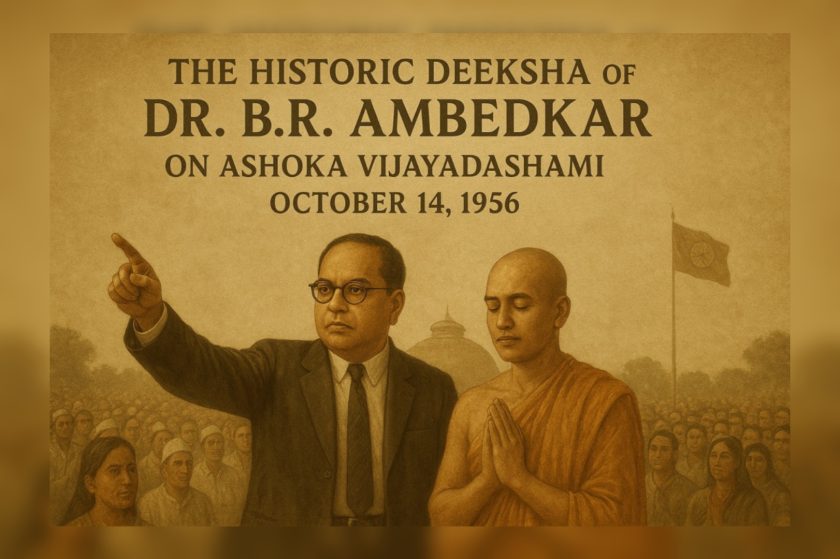
The Historic Deeksha of Dr. B.R. Ambedkar on Ashoka Vijayadashami
The Historic Deeksha of Dr. B.R. Ambedkar on Ashoka Vijayadashami: A Social Revolution That Changed India Forever
Introduction
History remembers not only kings and conquerors but also visionaries who changed the very fabric of society. On October 14, 1956, at Deekshabhoomi in Nagpur, India witnessed one of the most significant spiritual and social transformations of the 20th century Ambedkar’s conversion .
On this historic day, Dr. B.R. Ambedkar, the architect of the Indian Constitution and the leader of millions of oppressed people, renounced Hinduism and embraced Buddhism along with more than 500,000 followers. The day chosen for this monumental step was Ashoka Vijayadashami—a day celebrated for centuries as the victory of righteousness over injustice.
This was not merely a change of religion. It was the dawn of a social revolution, an act of reclaiming dignity, equality, and human rights for millions who had suffered caste-based oppression for centuries.
Also Read
Ashoka Vijayadashami: The Festival of Dharma, Victory & Inner Revolution
Samrat Ashok : महान मौर्य सम्राट का जीवन, युद्ध और बौद्ध धर्म की ओर यात्रा
Dalai Lama’s Successor: The Battle Between Buddhist Tradition and China’s Political Ambitions”
The Dhamma Policy of Ashoka: Lessons for Modern Governance
The Background: A Lifetime of Struggle Against Caste Oppression Ambedkar’s conversion
Dr. Bhimrao Ramji Ambedkar’s life was defined by a relentless struggle against untouchability, discrimination, and inequality. Born in 1891 into the Mahar caste, considered “untouchable,” Babasaheb faced humiliation at every stage of his life—denied water at school, segregated in classrooms, and insulted in public spaces.
Yet, through sheer determination and brilliance, he rose to become one of the most educated and respected leaders of his time. With doctorates from Columbia University and the London School of Economics, he returned to India to dedicate his life to social justice.
But despite his towering role in drafting the Indian Constitution and securing fundamental rights for citizens, he realized that caste oppression was too deeply entrenched in Hindu society. Legal reforms could not erase centuries of prejudice.
Thus, he began seeking an alternative—a spiritual and social path that would guarantee liberty, equality, and fraternity.
Why Babasaheb Chose Ashoka Vijayadashami
The date of October 14, 1956, was not random. It was carefully chosen.
Ashoka Vijayadashami marks the day when Emperor Ashoka, after the bloody Kalinga War, renounced violence and embraced Buddhism. For Ambedkar, this day symbolized:
- Victory of peace over violence
- Victory of equality over oppression
- Victory of compassion over cruelty
It also coincided with the Hindu festival of Dussehra, celebrated as the triumph of good over evil. By choosing this date, Babasaheb gave the festival a new, deeper meaning: the triumph of humanity over caste discrimination.
The Historic Day at Deekshabhoomi Ambedkar’s conversion
On the morning of October 14, 1956, Nagpur was charged with unprecedented energy. Trains, bullock carts, and buses brought lakhs of people from villages and towns across India. The ground at Deekshabhoomi was overflowing with eager faces, waiting for the moment that would change their lives forever.
At around 9 a.m., Dr. Ambedkar and his wife Savita Ambedkar stepped onto the dais. In front of a sea of humanity, he formally took Deeksha (initiation into Buddhism) from Bhikkhu Chandramani, a respected Buddhist monk from Burma.
The Conversion Ceremony
The ceremony began with the recitation of Trisharan (Three Refuges) and Panchsheel (Five Precepts):
- I take refuge in the Buddha.
- I take refuge in the Dhamma.
- I take refuge in the Sangha.
This was followed by the 22 Vows formulated by Babasaheb himself, in which he and his followers renounced Hindu gods, rituals, and caste practices, and committed themselves to living as Buddhists who value compassion, equality, and wisdom.
Some of the key vows included:
- I shall have no faith in Brahma, Vishnu, and Mahesh.
- I shall not perform Shraddha or Pind-daan.
- I shall not act against the principles of equality.
- I shall follow the noble eightfold path of the Buddha.
By reciting these vows, Babasaheb and his followers not only embraced a new religion but also broke the chains of caste slavery forever.
Also Read
Ashoka Vijayadashami: The Festival of Dharma, Victory & Inner Revolution
Samrat Ashok : महान मौर्य सम्राट का जीवन, युद्ध और बौद्ध धर्म की ओर यात्रा
Dalai Lama’s Successor: The Battle Between Buddhist Tradition and China’s Political Ambitions”
The Dhamma Policy of Ashoka: Lessons for Modern Governance
The Impact of the Deeksha
The conversion at Nagpur was not a private act of faith. It was a collective social revolution.
- For the first time in history, over half a million people renounced caste oppression in a single moment.
- It gave the Dalit community a new identity—no longer “untouchables” but Buddhists, heirs of a rational, egalitarian, and scientific tradition.
- It marked the rebirth of Buddhism in India, the land of its origin, after nearly a thousand years of decline.
Ambedkar’s Deeksha was therefore not only a personal liberation but also the beginning of a new chapter in Indian history.
Global Significance
Ambedkar’s conversion sparked a global interest in Buddhism. International Buddhist communities saw this as a revival of the Dhamma in its homeland. Scholars, monks, and leaders from across Asia recognized Babasaheb as a modern Dharmaraja (Righteous King) who brought millions into the path of the Buddha.
Today, the Ambedkarite Buddhist movement continues to grow in India and abroad, carrying forward his mission of equality.
Annual Deeksha Celebrations at Nagpur
Every year on Ashoka Vijayadashami, lakhs of people gather at Deekshabhoomi, Nagpur, to commemorate the historic event. Many new followers also take Deeksha, continuing Babasaheb’s legacy.
Deekshabhoomi has now become a global pilgrimage center for Buddhists, symbolizing the victory of social justice. The stupa at Deekshabhoomi stands as a monument of peace, equality, and resistance against injustice.
Modern Relevance of Babasaheb’s Deeksha
Even today, caste discrimination remains a challenge in Indian society. Babasaheb’s decision to embrace Buddhism is not just a historical moment but a living guide for those who seek dignity and equality.
- His 22 vows remind us to question blind faith.
- His choice of Buddhism inspires rational, ethical living.
- His Deeksha shows that true revolution begins with courage and conviction.
In an era where inequality still exists, Ambedkar’s Deeksha remains a blueprint for social transformation.
Also Read
Ashoka Vijayadashami: The Festival of Dharma, Victory & Inner Revolution
Samrat Ashok : महान मौर्य सम्राट का जीवन, युद्ध और बौद्ध धर्म की ओर यात्रा
Dalai Lama’s Successor: The Battle Between Buddhist Tradition and China’s Political Ambitions”
The Dhamma Policy of Ashoka: Lessons for Modern Governance
Conclusion
On October 14, 1956, Dr. Babasaheb Ambedkar did not simply change his religion—he changed the destiny of millions. By embracing Buddhism on Ashoka Vijayadashami, he gave his people the gift of dignity, hope, and freedom.
His Deeksha was not the end of a struggle but the beginning of a new revolution—a revolution of compassion, equality, and humanity.
Deekshabhoomi today is not just a sacred place but a reminder that true liberation comes not through rituals but through courage, knowledge, and justice.
Babasaheb’s message continues to inspire millions worldwide:
Educate. Agitate. Organize. And liberate yourself through wisdom.
Hashtags
#DrBRAmbedkar
#AmbedkarDeeksha
#AshokaVijayadashami
#Deekshabhoomi
#AmbedkarBuddhism
#Ambedkar22Vows
#SocialJustice
#BuddhismInIndia
#AmbedkarLegacy
#HistoryOfIndia
Note:
Jai Bhim! Namo Buddhay! Friends, welcome to Nagvanshingo. If you find any information on our page incorrect or if you would like to share any! additional! information! with us, please contact us at nagbbs50@gmail.com